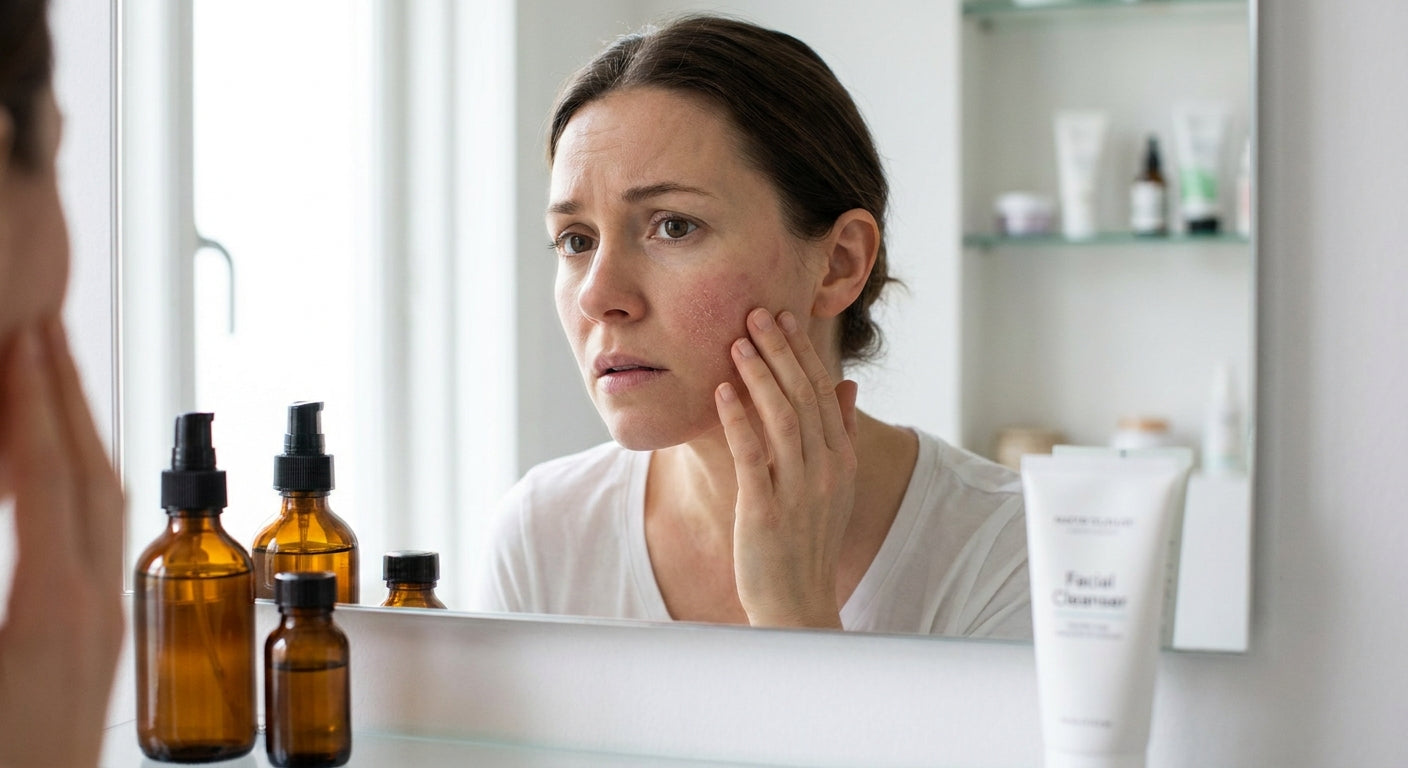
A cleanser that leaves your face tight, red, or squeaking after every wash isn't doing its job — it's stripping the layer that keeps your skin comfortable in the first place. This guide walks through the specific signs, a few checks you can run in under a minute, and what to switch to if your wash is too harsh for daily use in 2026.
- How to know if cleanser is too harsh: skin feels tight or squeaky within 5 minutes of rinsing.
- Check the label for sodium lauryl sulfate in the first five ingredients — a common harsh-cleanser marker.
- Gentle Cleansing Milk uses cold-pressed shea and argan and skips sulfates entirely: Buy if your skin tightens after washing.
- Redness or stinging within 10 minutes signals a pH mismatch; skin's natural surface sits near pH 4.7-5.75.
- Cleansing Foam suits oily skin that still needs a lower-strip formula than a standard foaming wash: Consider.
Why This Matters
Most men never question their cleanser until something goes wrong — flaking, redness, a tight feeling that lasts an hour after washing. By then the barrier's already irritated, and the fix isn't a better moisturizer layered on top. It's identifying what's actually causing the problem.
A cleanser that's too harsh usually does one of two things: it uses a high concentration of sulfates that strip natural oils faster than skin can replace them, or it sits at a pH far from skin's natural range. Skin's surface typically sits around pH 4.7 to 5.75. A cleanser that's alkaline, closer to pH 9 or 10, disrupts that balance every time you wash.
OLIRS makes Gentle Cleansing Milk with cold-pressed shea from West Africa and argan from a UNESCO-protected biosphere reserve in Morocco — sourcing you can trace, not a claim you have to take on faith. Read the INCI on any cleanser you're using now before you decide it's the problem. Sometimes the formula's fine and the issue is how you're using it.
What You'll Need
- Your current cleanser and its full ingredient list (check the box or the brand's product page)
- Two minutes right after washing to actually pay attention to your skin, not just walk away
- Decent light — bathroom lighting hides redness that daylight shows
- A notebook or phone note to track symptoms over a week, not just one wash
- Optional: a pH test strip, sold cheap online, if you want a number instead of a guess
The Steps
1. Check the ingredient list for sulfates
Look at the first five ingredients on the label. If you see sodium lauryl sulfate or ammonium lauryl sulfate near the top, that's your strongest harsh-cleanser signal. These surfactants clean fast and lather big, which is exactly why they're overused in mass-market face washes built for cost, not skin.
Sodium laureth sulfate (note the "eth") is milder than its lauryl cousin but still worth noting if it's high on the list. Expected outcome: you'll know within 30 seconds whether the formula is built around aggressive surfactants. Common mistake: assuming a cleanser is gentle because it's marketed as "for sensitive skin" — check the actual list, not the label copy.
2. Run the tightness test
Wash your face with your normal cleanser, pat dry, and wait five minutes without applying anything else. Tight, squeaky, almost stretched skin is the barrier telling you it lost more oil than it should have.
A cleanser doing its job leaves skin feeling clear and comfortable, not stripped. Expected outcome: a clear yes/no on whether this specific formula overshoots. Common mistake: applying moisturizer immediately after washing, which masks the tightness and hides the signal you're testing for.
3. Watch for redness in the first 10 minutes
Redness that shows up fast, not hours later, usually points to irritation from the wash itself rather than something environmental. Check under good light, focus on the cheeks and around the nose where skin tends to be thinner.
This is a pH clue as much as an ingredient clue — alkaline formulas provoke this reaction more than pH-balanced ones. Expected outcome: visible redness confirms the cleanser, not diet or weather, is the variable. Common mistake: blaming a new redness on "sensitive skin" as a permanent trait instead of testing whether it's formula-specific.
4. Count how many times a day you're washing
Twice a day — morning and after activity that makes you sweat — is the standard most dermatology guidance lands on. Three or more washes a day with any cleanser, even a gentle one, can strip skin faster than it recovers, regardless of the formula.
Expected outcome: you isolate whether the problem is the product or the frequency. Common mistake: doubling up washes after a workout and again before bed, treating cleansing like it needs to happen every time you think about your skin.
5. Check the water temperature
Hot water feels good and does real damage — it strips lipids from the skin barrier on its own, independent of what cleanser you're using. Lukewarm water, closer to body temperature, does the same cleaning job without the extra strip.
Expected outcome: switching to lukewarm water alone sometimes resolves tightness even with the same cleanser. Common mistake: cranking the shower hot and washing your face under the same stream without adjusting.
6. Patch-test a milder formula for three days
Swap in a cleanser without sulfates for three straight days and repeat the tightness test each time. Three days is enough to see a pattern without needing weeks of data.
Expected outcome: if tightness and redness drop by day two or three, the original cleanser was the harsh variable. Common mistake: switching cleansers and moisturizers at the same time, which makes it impossible to know which change fixed anything.
Troubleshooting
Skin's still tight after switching to a gentler cleanser. Check water temperature and wash frequency before blaming the new formula — both variables can override even a well-formulated cleanser.
Breakouts appeared right after switching cleansers. Some formula changes cause a short adjustment window as skin recalibrates oil production. Give it a full week before deciding the new cleanser isn't working; if breakouts persist past that, the formula likely isn't the right match.
Stinging specifically around the beard line or jaw. That's usually friction and product residue trapped in facial hair, not the cleanser itself. A gentle facial cleanser built for sensitive skin walks through rinsing technique that matters as much as the formula.
Oily skin feels stripped even by a "gentle" cleanser. Gentle doesn't always mean low-cleansing. Some lightweight foaming formulas balance a lower-strip base with enough surfactant to handle oil without overshooting.
Can't tell if it's the cleanser or something else. New laundry detergent on your pillowcase, a fresh SPF, or a change in humidity can all mimic cleanser irritation. Isolate one variable at a time before you conclude it's the wash.
Tools and Resources
- Ingredient list on the product page — read it before you buy, not after you react to it
- Cleansing Foam for oilier skin that still needs a formula built around a lower strip factor than a standard foaming wash
- A pH test strip, if you want to confirm rather than estimate where your current cleanser lands
- COSMOS NATURAL certification, held by OLIRS, means a third party audited every ingredient and how it was extracted — it's not a claim you take on faith, it's a record you can check
- Your own week-long log from the steps above — the single best diagnostic tool, and it's free
What to Do Next
Once you've confirmed your cleanser is the problem, the next move is matching a formula to what your skin's actually reacting to, not just picking whatever's labeled "gentle." If redness and stinging are the recurring issue rather than just tightness, a face oil built for reactive, easily irritated skin covers the layer that comes after cleansing, which matters just as much as the wash itself.
FAQ
What's the best way to tell if a cleanser is too harsh?
Wash your face, wait five minutes without applying anything, and check for tightness or a squeaky feel. That sensation means the cleanser stripped more oil than your skin barrier can replace on its own.
Is tight skin after washing normal?
No, tight or squeaky skin after cleansing usually means the formula is too aggressive or the water was too hot. A cleanser working correctly leaves skin feeling comfortable, not stretched.
Can a harsh cleanser cause breakouts?
Yes, stripping skin's natural oils can trigger it to overproduce oil in response, which shows up as breakouts days later. This is more common with sulfate-heavy formulas used more than twice a day.
What ingredients make a cleanser too harsh for men's skin?
Sodium lauryl sulfate and ammonium lauryl sulfate near the top of an ingredient list are the clearest markers. Both clean fast and lather heavily, which strips more than skin needs to feel comfortable.
How often should men wash their face?
Twice a day covers most routines: once in the morning, once after activity that causes sweating. Washing more than that, even with a gentle cleanser, can overwhelm the skin barrier.
Is a foaming cleanser too harsh for sensitive skin?
Not automatically — foam level depends on the surfactant used, not just the texture. Check the ingredient list rather than assuming foam equals harsh.
Does water temperature affect how harsh a cleanser feels?
Yes, hot water strips lipids from skin independent of the cleanser itself. Switching to lukewarm water often reduces tightness even with the same formula.
Is COSMOS Natural certification relevant to how gentle a cleanser is?
It confirms sourcing and extraction were third-party audited, not that a formula is automatically gentle on every skin type. Check the full ingredient list alongside any certification before deciding.
One Last Thing
Skin's natural surface pH sits around 4.7 to 5.75 — most alkaline bar soaps land closer to 9 or 10, which is the single biggest reason bar soap on the face causes more tightness than a dedicated facial cleanser ever will. If you're still using the same bar soap on your face and body, that's usually the fastest fix available before you even change products.